By: Krisha Sikka
Written for CTCS 191: INTRODUCTION TO TELEVISION AND VIDEO
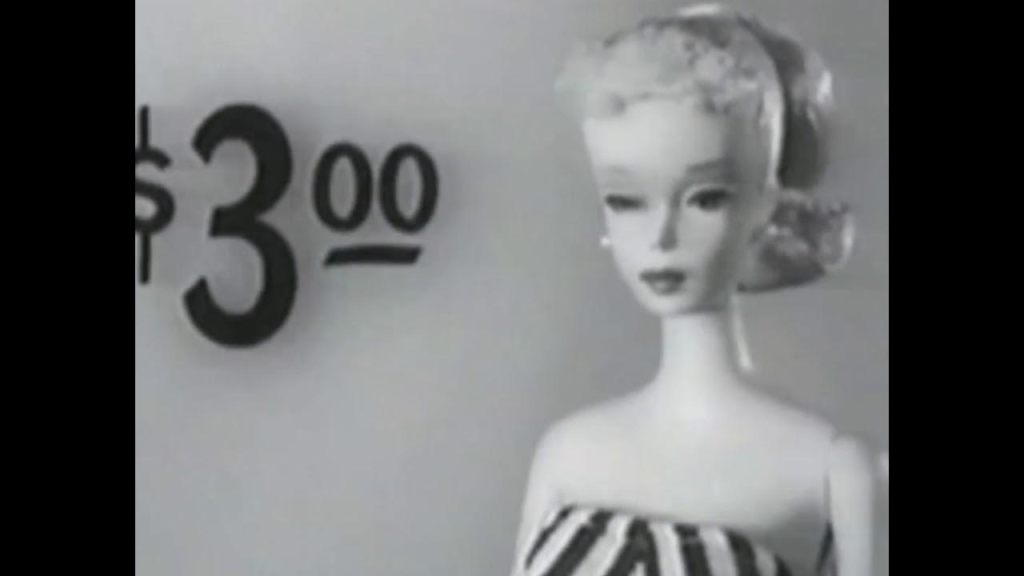
During the 1950s, women switched from a penchant toward gender progressivism to conservative positions in society after major casualties from World War II (WW2) and the Great Depression. Many Americans turned to these stereotypical and patriarchal roles as sources of familiarity, comfort, and normalcy, as they so desperately sought stability. To disseminate such hegemonic ideals in society during this time period, individuals began to curate advertisements for distribution via television on popular networks. One example of such is the 1959 Barbie commercial “Barbie You’re Beautiful,” which established the idea that the ultimate status of a woman in society is achieved when she assumes the role of a petite bride and dedicated housewife.
According to Cynthia B. Meyers’s work “From Sponsorship to Spots: Advertising and the Development of Electronic Media,” the transition to television towards being the main source of entertainment and away from radio brought a multitude of changes for advertisements and how they were distributed. Previously, advertisers had been reluctant to force serious ideals onto their audiences due to wanting to allocate space for individuals to have different views. However, when the Great Depression occurred, companies instead had to resort to making the most of money that they could through “hard sell” strategies. Furthermore, in the past, advertisements were built into the radio shows that they were featured in and therefore had to be relevant to the discussions taking place. However, with the rise of television, it allowed for advertisements to exist separate from the shows and rather through negotiations with the TV company, which made advertisers more concerned about the audience that they were reaching out to rather than the genre and type of entertainment that had come before it. With this transition to the visual sphere, production costs skyrocketed, but there also began a new form of advertisements that were able to use various elements to attract viewers to products, rather than them simply being spoken about (Meyer 70-74).
Thus, with a concern about the audience and acquiring the most amount of money that they could, Mattel International became one of the first toy companies to use television to attract mass audiences. Airing on ABC during the duration of The Mickey Mouse Club, the commercial “Barbie You’re Beautiful” aimed to attract young, easily influenced young girls who sought to have women to look after as role models (“The First Ever Barbie Commercial”). With this ad opening up with a beautiful bride holding flowers with the Barbie logo on them, the audience is immediately encapsulated with the blonde woman’s beautiful wedding dress and content expression. The lyrics “Barbie is small and so petite” echoes in the back as the viewer acknowledges the mainly blonde and brunette dolls prancing around in big, poofy dresses (Mattel). Therefore, Mattel does a great job at not only setting the beauty standard to a blonde, skinny white woman but also encouraging young girls right off the bat to unlock their inner beauty through becoming a bride.
Furthermore, the advertisement also sets up a heteronormative gender norm where women are responsible for maintaining the household. Despite women being active in the labor force during WW2 such as factory workers to create weaponry, the numerous American casualties led to a call for return to “normalcy.” This notion of normalcy was rooted in traditional gender roles – that women’s realm is the private sphere whereas as the breadwinner, the men’s is the public one. Traumatized by fighting, Americans now fought for a flawed sense of peace. Thus, various media indoctrinated young girls by brainwashing them to revere marriage and domestic life as central goals, with every other aspiration being secondary. For example, the Barbie commercial even includes one of the dolls holding a plate of food and wearing an apron. The barbies were also described as being solely interested in fashion in their experience, which assisted in reiterating the confinement of women as not having complex interests (Mattel).
Another tactic that Mattel used to influence young women into believing that being the ideal bride was what they should strive to be is that they placed the bride Barbie at the top of the staircase with all the brides. By placing her in a higher position, young women view marriage as a way to achieve their highest form of beauty and status, and the line “I’ll make believe that I am you” reiterates how the audience could use these dolls to daydream about one day being a bride. Specifically, young women who did not fit the skinny, blonde hair and blue eyes image could use the dolls to take upon the roles of these so-called “perfect” women and escape from the reality of how they were viewed as less than in society (Mattel).
Therefore, this advertisement proved to be effective in reinforcing the idea that a woman’s main place in society is the household and that young women should aspire to one day be a beautiful bride. With more than a billion dolls being sold since this commercial first aired, the advertisement was most likely extremely successful in launching the company due to the transition that Meyers further elaborates on in her chapter during the 1950s (Dockterman and Lang). Due to an increase in “television advertising from $454 million in 1952 to $1.6 billion in 1960”, the network, ABC in this case, began to take control over how the advertisements were distributed. Despite being seen somewhat negatively due to this very lack of control that advertisers now held, many, including Mattel, were able to transfer the burden of distributing their brand to the networks itself. With an ability to now move freely across networks due to not being tied to a specific show, Barbie’s advertisements and Mattel overall flourished and represented fashion trends and an unrealistic, lasting beauty and lifestyle standard for young women (Meyer 74). Now, the movie Barbie is available on streaming services, which are also incorporating advertisements for other brands, continuing the cycle (Kelly). And, it would simply not have been possible if the USA had not only been fragile and seeking normalcy after the Great Depression and World War II but also involved in the rise of television as a medium for visual advertisements to attract mass audiences.
Works Cited
Dockterman, Eliana and Cady Lang. “How Barbie Took Over the World.” Time, 25 July 2023, https://time.com/6294121/barbie-movie-popularity-impact/. Accessed 30 October 2024.
Mattel, “Barbie You’re Beautiful.” Youtube, uploaded by Ye Olde Cinema, 9 March 1959, https://www.youtube.com/watch?v=0_AITmAC6HA.
Meyers, Cynthia B. “From Sponsorship to Spots: Advertising and Development of Electronic Media.” Media Industries: History, Theory, and Method, edited by Jennifer Holt and Alisa Perren, Wiley-Blackwell, 2009, pp. 69-78.“The First Ever Barbie Commercial.” Eyes of a Generation…Television’s Living History, 28 October 2014, https://eyesofageneration.com/speaking-of-toys-here-is-the-first-ever-barbie-commercialthis-is-reported-to/. Accessed 30 October 2024.
 KRISHA SIKKA
Leave a comment