By: Krisha Sikka
Created for ASCJ 200: NAVIGATING MEDIA & NEWS IN THE DIGITAL AGE
For the most part, going to the doctor is simple. A patient presents their issue and leaves the appointment with a solution, feeling optimistic that they will hopefully have a fairly simple recovery.
However, things begin to become complicated for individuals who do not speak the same language as their healthcare provider and thus find themselves victim to a language barrier. Suddenly, they aren’t able to describe their symptoms and can even have their medical issues go undiagnosed.
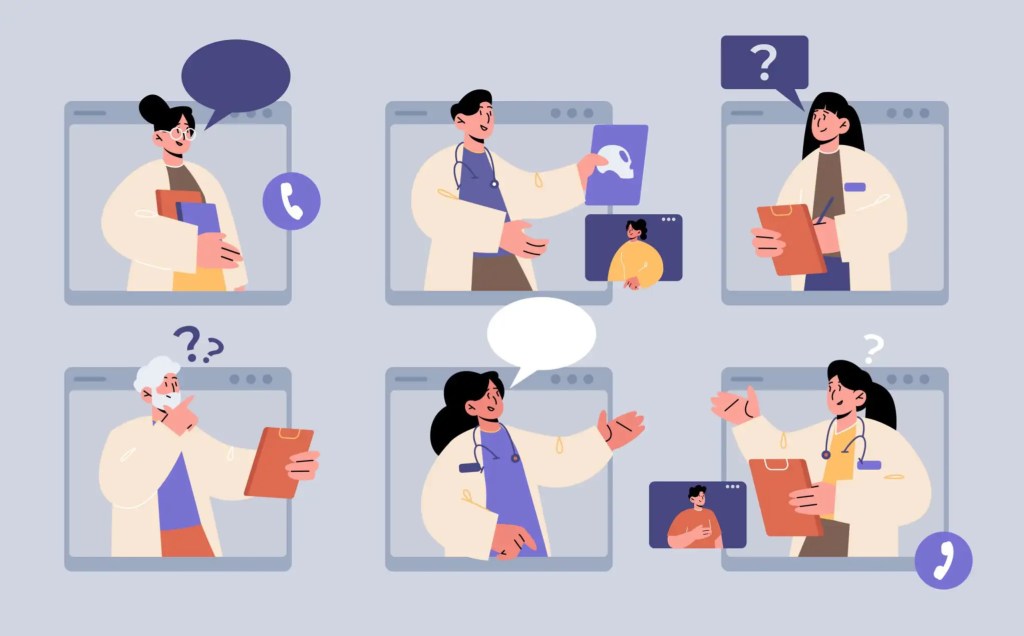
For example, according to the National Library of Medicine’s article “Implications of Language Barriers for Healthcare: A Systematic Review,” there has been much research surrounding and supporting the claim that those who were not proficient in English were more likely to receive a misdiagnosis or adverse health outcomes when compared to those who were proficient in English.
However, this research not only presented the issue of language barriers in healthcare but also a solution: incorporating translations tools into medical visits in order to increase not only patient but also provider satisfaction.
Now, let’s take a closer look into how technology and online services can help improve the quality of healthcare visits for those influenced by language barriers.
According to the article “Usability of Technological Tools to Overcome Language Barriers in Healthcare: A Scoping Review Protocol,” which is also published via the National Library of Medicine, technological tools can help reduce the need of actual interpreters being present during appointments. The research discusses machine translation, “where users can write or speak the sentences and translations are provided instantly by artificial intelligence.”
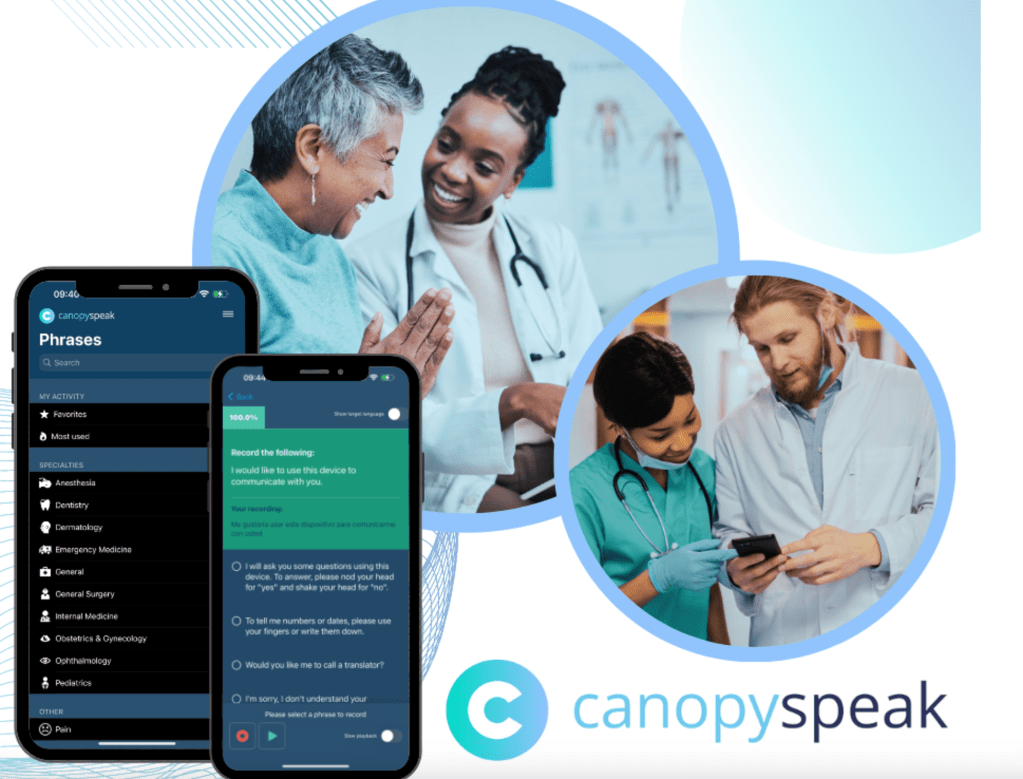
While these platforms are definitely not perfect, technology and A.I. are constantly improving to include a wider variety of phrases and images to cover medical issues; there are even apps that are being developed as well. For example, the app CanopySpeak, is developed for providers to practice common medical phrases in foreign languages in order to utilize them when involved in patient care. Its incorporation of speaking exercises and 22 languages overall is carefully curated by linguistic experts who have years of experience in the healthcare system.
Thus, in the remix video that I had to compose for class, I decided to incorporate found footage discussing not only the severity of the language barrier in healthcare but also how technology has advanced to mitigate this issue. I included real-life examples of people from all demographics discussing how they were unsure and worried about communicating their medical needs. While A.I. can sometimes be seen as overly powerful and even scary by the general public, I included clips that supported its usage in a medical context in which words and symptoms are able to be translated and understood fairly quickly. And, in this sense, I really do believe that technology is here to help and should be advanced to further tackle the issue of language barriers in healthcare.

 KRISHA SIKKA
Leave a comment