By: Krisha Sikka
Written for CTCS 392: HISTORY OF AMERICAN CINEMA TO 1960
During the 1920s and 1930s, the United States of America faced numerous crises that affected almost every aspect of life. With individuals undergoing the continual aftermath of World War I and the issuing of the Prohibition, the Great Depression loomed over Americans that were simply trying to make ends meet. Thus, many individuals turned to gangs and illegal activities as means to support themselves, even taking advantage of the ban on alcohol and turning it into a lucrative, illegal business for sellers.
American cinema aimed to portray the struggles that individuals were facing and did so in numerous ways and even showed how gang violence infiltrated the lives of those involved. On one hand, some filmmakers would glorify the lives of gangsters by saying their extreme riches and power that arose from their amassed wealth and possession of weapons was somewhat admirable. However, the 1932 film Scarface, directed by Howard Hughes, took a different angle, ultimately aiming to encourage the government and American citizens to take action against violence in their communities.
Based upon real-life gangster Al Capone, this film portrayed how gangster Tony “Scarface” Camonte became involved in the sale of illegal alcohol in Chicago and eventually turned into a ruthless and brutal man, shooting down any person who came into his way and prevented him from living his life of crime. Eventually losing his life through the hands of the police, Camonte’s insanity was depicted as being glorified by newspaper companies that aimed to profit off of public investment in gang violence and partially due to inaction from the police and the government in taking him down. However, despite many attempts to censor Scarface for its inclusion of gang violence and harsh truths regarding societal concepts, the film was able to successfully be screened and viewed by the public as a powerful expose of America’s underworld.
During this era of cinema, Hollywood was rarely known for dipping its toes in taboo controversial topics, but when it did, it was often faced with much backlash. According to the New Movie Magazine July-December 1934 issue’s article “Hollywood Titles,” the government during this time was opposed to films that made them look bad. They did not want to come across as ineffective and unable to enforce law among the people, so films that showed crime and illegal activities were viewed as undermining the authority of higher, federal power and enforcement. Furthermore, this idea did not extend only to the United States but also to foreign nations, who wanted to be seen as powerful and authoritative in the midst of recent ways and relations.
Therefore, when it came to Scarface, thousands of feet of reel footage had to be shot again due to the fact that Camonte and his affiliates were displayed as of Italian origin. According to Will Hays, a devout Catholic who wanted films to appeal universally to all and thus was responsible for various production codes that kept films conventional, it made more sense to leave the nationality of the gangsters as unknown, which is eventually something that the director had to succumb to. After all, it did not really change the overall message of the film and helped avoid unnecessary foreign conflict.
However, there continued to be much conflict between Hughes and the Motion Pictures Producers and Distributors of America (MPPDA), as they urged him to take a more anti-gun approach on the film and depict the gangster as much less powerful and more cowardly due to pursuing dishonest work. According to the magazine Motion Picture Herald issue from April to June 1932, the article “Hughes and Censorship” described that Hughes was often faced with censorship backlash. His publicist Mr. Lincoln Quarberg often fought his battles for him, who even seemed enticed by the fact that Hollywood had launched so many investigations into whether his films were too problematic.
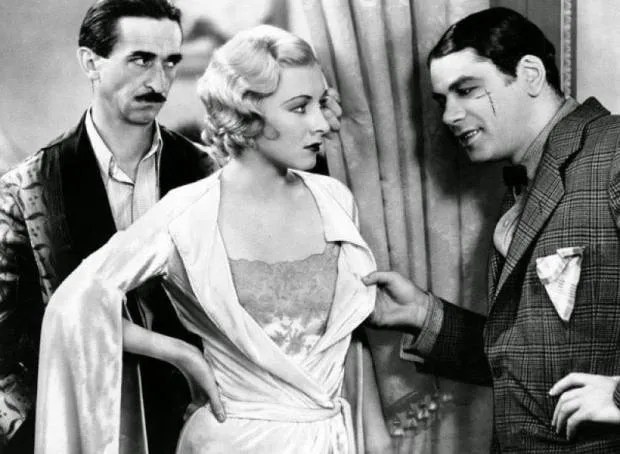
One of the main questions that arose surrounded how making a hero out of gangster would be perceived to the public eye. After all, if the main point of the film was to deter audiences from glorifying gang violence, it seemed a bit counterintuitive to include a character that was perceived favorably by his family members and was able to conquer his archnemesis, the detective, through his eventual death. Thus, instead, the Hays office requested that Hughes comply through having his mother and sister ridicule him for his life of crime and face turmoil from it. Specifically, when Francesca, Camonte’s sister, is in shambles and tells their mother how her brother shot Guino, her lover, the mother ridicules him and scolds him for bringing a life of crime and shame onto the family. However, all was not lost through this inclusion because there were elements that were able to slip through the censorship. For example, during the final scene, Cesca raises a gun at Tony and is able to kill him if she chose; however, instead, they share an intimate moment and hold each other, as police officers begin shooting their guns into their window. This scene has been argued as hinting at elements of an incestual relationship, which was further reinforced by Camonte’s uncharacterized protective and aggressive nature when he sees his sister dancing on another man, and reinforces the idea that not everything was lost by the censorship attempts.
Furthermore, Al Capone, the real life gangster whom Tony “Scarface” Camonte was based off of, even showed opposition towards the film’s release. In an interview with him during the 1930s, he stated that screening such a film would be harmful to children, as they would be exposed to the brutality of gangs and the underworld. With Paul Muni’s, the actor of Camonte, appearance highly resembling Capone and reference to the gangster’s real home in Miami, there was no doubt that such a story would instead be perceived slightly as non-fiction, rather than resembling a film that originates from the imagination of the fiction writers. On top of that, the inclusion of the name Scarface as the title was seen as problematic because of the fact that it was also used to directly refer to Al Capone himself. Instead, censorship boards even requested – unsuccessfully, however – that they included an uplifting title instead that helped reinforce the false notion that America was successfully handling the gang violence crisis. Furthermore, there were even references to true gang events – such as the St. Valentine’s Day Massacre and the shooting of Tony Lombardi, a gangster florist – which gave strict confirmation to the idea that the underworld exists to the public.
And, despite these documented changes that occurred during the production and distribution of Scarface, it seems as if the general public agreed that this gangster film still proved to be extremely successful and influential. According to the Hollywood Filmograph’s issue from January-December 1932, the article “Howard Hughes Wins Scarface Fight in New York” describes how the censorship board was originally not allowing Scarface to be screened anywhere because of the inclusion of violence and bloodshed. More specifically, up to this point, despite many organizations not wanting to reveal themselves as advocating for censorship because it was perceived as un-American and infringing upon one’s rights, individuals on both sides of the Prohibition were offended regarding the inclusion of alcohol. On one hand, showing how alcohol was able to fuel the wealth of gang members offended those that believed that the sale should be legal and was not in fact harmful to society. On the other hand, people opposed to the sale of alcohol did not believe people should even be encouraged to drink it or engage in its sale through seeing it on the big screen.
Furthermore, it was illegal to show the police as being ineffective for an extended period of time, and it seemed as if Camonte was able to conquer many of his competitors before the police took him down. This idea also called into question whether law enforcement and political leaders were in fact crooked and profiting off of gang-related activities, which was evident due to the increased amount of money that they had, and thus were not taking action in terms of mitigating associated violence. And, after all, the reason that Camonte was taken down is not solely due to the power of the police but also because he had lost or alienated himself from everybody around him.
It is also worth noting the manner that Tony “Scarface” Camonte lost his life in the film and how this was contested by the censorship boards. In the original cut of the film, the Hays code believed that it was too dramatic to have Camonte die at the end, rather than face the wrath of the prison system. Thus, they demanded that they re-record it to show Camonte being arrested by the police, which was originally something that Hughes complied with. However, they later insisted that it undermined the true meaning of how brutal and unforgiving a life of crime was and kept the ending in which Camonte refuses to surrender and is instead met with rounds of gunfire. His cold, lifeless body even turns yellow at the end, depicting that he was a cold-hearted killer and set him apart from other men of this era. This powerful message was not seen in a good light in many states and was thus not allowed to be screened, which called into question whether the film would be able to reach a mass audience.
But, in the end, Hughes’s film was able to be screened and revealed unpleasant political truths surrounding the rise of gangs and gun violence. Although censorship boards had affected many theaters worldwide, it was still able to gain much popularity and change the gangster genre overall. Once seen as a genre that glorified the livers of gangsters, such as through films including Little Caesar and The Public Enemy, Scarface instead went down as a major film that people perceived as necessary for Americans to view and be exposed to in order to gain the knowledge that the underworld truly existed. Paul Muni’s career was even transformed because of how memorable and crucial his role was and went down in history as the first man that was able to truly capture the essence of the gangster. Although possessing much fame, he chose to possess a quiet and humble life and felt as if the film itself placed certain expectations on him to act as a gangster due to his extremely accurate performance. Thus, Scarface has gone down in history as a true gangster film that exposes the vices of the underworld, and despite facing opposition in Hollywood for being overly taboo, it was able to go down in history and forever change the gangster genre. It also encouraged individuals to take control and use their voices in the government because as the famous banner depicts in the movie, “The world is yours.”
Works Cited
“Censoring the Censors,” Broadway and Hollywood Movies, January-December 1932.
“Close-ups and Long-shots,” Photoplay, July-December 1932.
“Hollywood Titles,” New Movie Magazine, July-December 1934.
“Howard Hughes Wins Scarface Fight in New York,” Hollywood Filmograph, January-December 1932.
“Hughes and Censorship,” Motion Picture Herald, April-June 1932.
“Paul Muni Interviews Himself,” Motion Picture, August 1933-January 1934.
“Scarface 1932.” AFI Catalog of Feature Films: The First 100 Years 1893-1993. American Film Institute, Accessed December 4, 2024. “Shall the Movies Take Orders from the Underworld?” Movie Class, April-August 1932.
 KRISHA SIKKA
Leave a comment